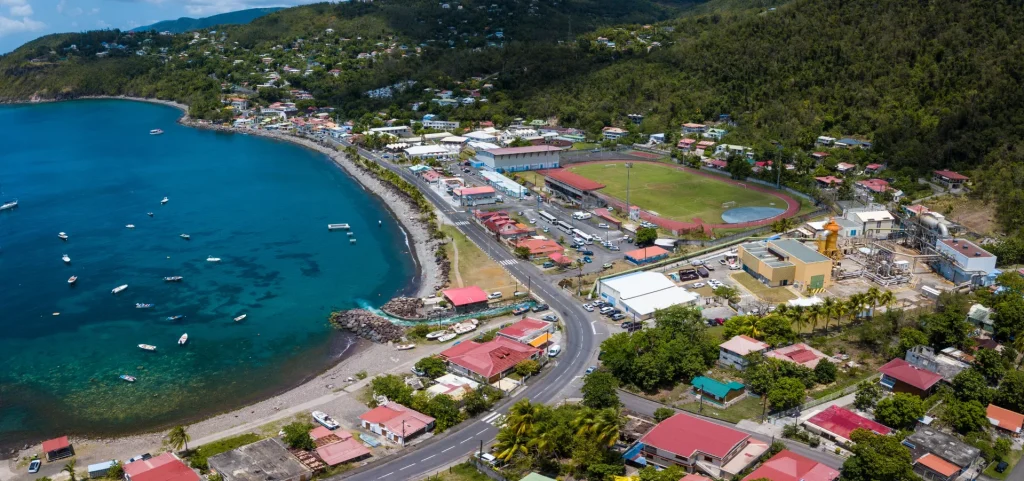
Bouillante is the base for the Cousteau Reserve, on the leeward coast of Basse-Terre, about 45 to 60 minutes by car from Pointe-à-Pitre airport. It is one of the oldest municipalities in Guadeloupe and stretches along 15 kilometers of coastline. The name comes from the hot water that rises from beneath the sea, and the town now has the only geothermal power plant in France, which covers roughly 7% of the island’s electricity according to recent reporting.
It sits on the west side of Basse-Terre Guadeloupe, wedged between the Caribbean Sea and the national park forest. Divers and snorkelers come for the reserve, and the area is also known for its Bouillante restaurants, most of them within a few minutes of the sea.
Bouillante at a glance
Five facts that frame the visit: where it is, how far from the airport, how many people live here and what the town is known for.
| Fact | Detail |
|---|---|
| Location | Leeward coast of Basse-Terre, on National Road N2 |
| From the airport | About 45 to 60 minutes by car from Pointe-à-Pitre |
| Population | 6,381 residents (INSEE, 2022) |
| Postal code | 97125 |
| Known for | Cousteau Reserve, hot springs, geothermal power plant |
A name that says it all: volcanic heritage
The name is not anecdotal: it comes directly from the local hot springs. On the leeward coast of Basse-Terre, the ground and the sea water are warm because of the volcanic activity of the island’s mountain range, dominated by La Soufrière volcano.
That volcanic heritage explains most of what you see here: the springs, the geothermal plant and the black sand.
The geothermal power plant
The Bouillante geothermal power plant is France’s only plant of its kind. Boiling water is drawn from deep underground and the steam drives the turbines, which gives Guadeloupe clean electricity. Recent reporting puts its share at about 7% of the archipelago’s electricity needs, and a third unit planned for the end of 2026 is meant to roughly double its output.
Once cooled, the water released back into the sea creates pleasantly warm bathing areas, an unexpected side effect that local swimmers enjoy.
Between the Caribbean Sea and the national park
Bouillante sits between the calm waters of the Caribbean Sea and green mountains, and the geography leaves no room for a gradual transition. Dense tropical forest begins just behind the coastline, which makes it an easy gateway to the Guadeloupe National Park: in a few minutes you move from deep blue to deep green.
Flo’s advice
Plan two half days here, not one. The morning is for the water (reserve, springs, beach) and the afternoon for the forest side, because the heat on the coast is hard to take after noon and the trails above are cooler.
Diving and the Cousteau Reserve
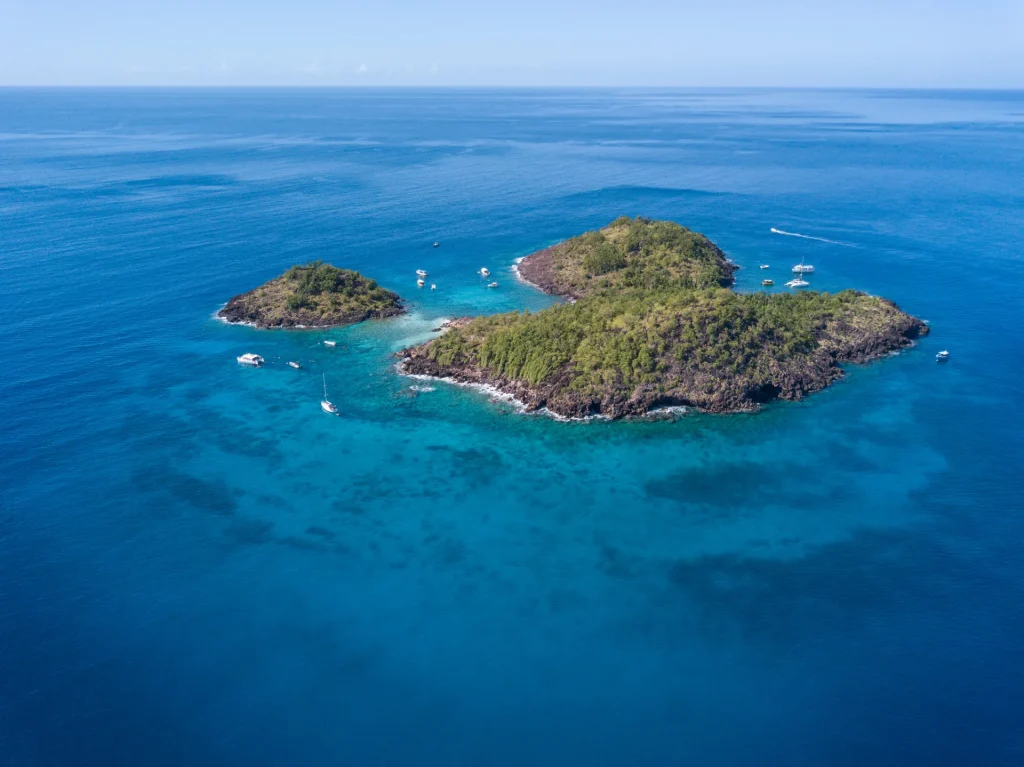
Coming here without exploring the Cousteau Reserve would be a major mistake. The reserve is the heart of the national park’s marine area and surrounds the Pigeon Islets, facing Malendure, the beach where almost every boat, kayak and dive center operates. For centers, depths and sites, see our guide to diving in Bouillante.
The Pigeon Islets, a life-size aquarium
The site owes its name to Commander Cousteau himself, who strongly advocated for its protection. You do not need to be an expert to enjoy it: snorkeling alone is enough to be amazed, while scuba diving gives access to deeper sites.
A bronze bust of Jacques Cousteau rests underwater at 12 meters, on the Coral Garden site. It sits on a drop-off with barracudas, so it is a dive for certified divers, not a snorkeling stop.
Marine life and underwater landscapes: what to expect
The diversity beneath the surface is rich. Here is what you are likely to encounter:
- Sea turtles: often seen grazing on seagrass near Malendure Beach.
- Colorful tropical fish: parrotfish, sergeant majors, grunts and blue tangs.
- Coral gardens: pillar corals, gorgonians and sponges carpet the seabed.
- Rarer encounters: with some luck, barracudas, lobsters or even dolphins farther offshore.
Affiliate link · same price for you
Tips for diving or snorkeling
The reserve is easy to reach and still deserves a plan. These are the three rules I give friends before they go.
Do not try to be a solo hero. I strongly recommend going through one of the certified dive centers on Malendure Beach for a guided and safe outing.
The tip that changes everything
Book the morning session. Visibility is better and the afternoon crowds are not there yet. If you do not dive, a glass-bottom kayak is the easy alternative.
Remember the golden rule: look with your eyes only. Do not touch corals or marine life, in order to protect the ecosystem.
Hot springs and beaches in Bouillante
In Bouillante, water is not only experienced below the surface. The hot springs and a handful of beaches are the other half of the visit, and the hot springs are free.
Natural hot springs: where to relax
Cracks in the earth’s crust let seawater seep in. It heats up near the volcanic system under La Soufrière, then rises back to the surface. That is why the water steams.
Two spots are the usual stops. Bain du Curé is at the end of Anse à Sable beach, an easy-to-reach cement pool right by the sea. Source Thomas is a tiny rocky basin where the water mixes with the cold sea, and the temperature can rise quickly. Be careful: it can be scalding, so always test the water with your hand before getting in. Sources disagree on the exact access to Source Thomas, so ask a local before you walk down.
Black sand or light sand? Beaches not to miss
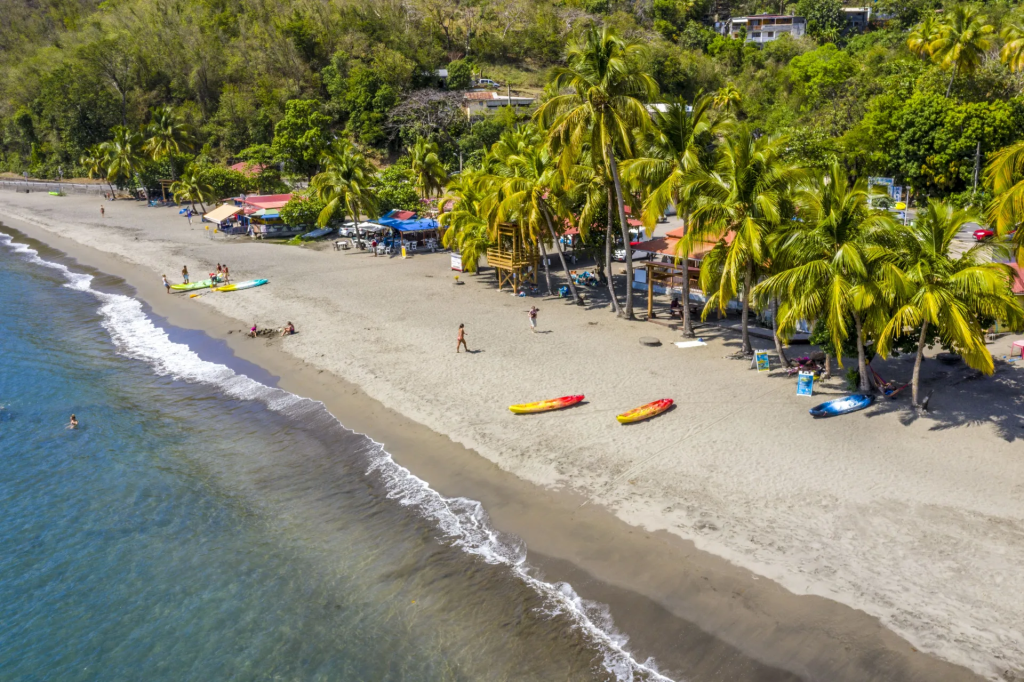
Malendure Beach is the one to see. Its volcanic black sand gets hot underfoot, but it is the main base for trips to the Pigeon Islets. Farther south, Petite Anse Beach is quieter and calmer, which suits families. Do not confuse it with another Petite Anse near Deshaies. For every beach on the coast, including the smaller coves, see more about Bouillante beaches.
Find your ideal swimming spot
A short table to choose at a glance, based on what you want from the water and how much crowd you tolerate.
| Swimming spot | Type | Ideal for | Key features |
|---|---|---|---|
| Malendure Beach | Beach (black sand) | Diving, lively atmosphere | Watersports center facing the Cousteau Reserve, restaurants, parking |
| Petite Anse Beach | Beach (light sand) | Families, tranquility | Shallow and calm waters, local feel, less crowded |
| Bain du Curé | Hot spring | Easy-access relaxation | Cement pool by the sea, free, popular in the late afternoon |
| Source Thomas | Hot spring | A more natural soak | Small natural basin, very hot water (test before entering) |
| Pigeon Islets | Snorkeling / diving | Underwater exploration | Access by boat or kayak, maximum biodiversity, protected site |
Hiking and nature beyond the water
If you pull yourself away from the sea, Bouillante has plenty to do on land: the forest of the national park, a canopy walk and old plantation sites. The full list is in our guide to things to do in Bouillante.
Trails of Guadeloupe National Park
Bouillante sits directly against Guadeloupe National Park. A dense, humid tropical forest covers the steep slopes behind the coast, far from seaside postcard imagery.
Try an accessible trail that climbs toward a river or waterfall. The contrast between the heat of the coast and the sudden coolness of the forest is the best part.
Parc des Mamelles: a walk in the canopy
Parc des Mamelles, home of the Zoo de Guadeloupe, is on the Route de la Traversée and fits into an itinerary without long drives. The highlight is the set of suspended walkways about 20 meters above the ground, with a view over the canopy and many Caribbean species. It is open daily, 9 am to 6 pm per its listing, and it works well with children.
It is one of the activities to add if you are wondering what to do in Guadeloupe.
Other stops in the highlands
- La Maison du Cacao (Pointe-Noire): a stop on the history of cacao in Guadeloupe, from the pod to the chocolate bar. The cocoa walk is by reservation.
- Habitation La Grivelière (Vieux-Habitants): a historic coffee plantation in a green valley, inside the national park, about 6 km of small road from the D27.
- Canyoning: the rivers coming down the slopes make guided canyoning routes, supervised by professionals.
Planning your stay in Bouillante
Three practical questions decide the trip: how you get around, where you sleep and when you come.
How to get to Bouillante and get around
Renting a car is essential if you want to explore Bouillante and its steep hills. From Pointe-à-Pitre Airport, allow about 45 minutes to one hour by car.
Once there, getting around is straightforward, since National Road N2 crosses the town and loops around Basse-Terre. Do not rely on local buses for sightseeing: schedules are irregular and routes are fixed.
Where to stay
Gîtes and vacation rentals are the main choice here, often villas and bungalows with views of the Caribbean Sea. A few small boutique hotels offer more services, and some ecolodges sit in the hills among the vegetation. Our page on Bouillante hotels goes through each type.
Book well in advance if you plan to visit between December and May.
Compare hotels in BouillanteAffiliate link · same price for you
Safety and the best time to visit
For the best sunshine, aim for the dry season, from December to May. The wet season (June to November) is generally cheaper, with short but intense tropical downpours.
Stay cautious in the water and at the springs. Always test the temperature of hot springs before getting in, and listen to the dive instructors’ briefing.
Bouillante is a quiet town, but basic vigilance still applies. For a broader view, see our guide listing neighborhoods to avoid in Guadeloupe.
Between swimming with turtles, natural hot springs and jungle right next door, Bouillante is the stop I would not cut from a Basse-Terre trip.
Before you go
Book your rental car before you land. Bouillante is spread along the coast road and the bus network will not get you from the hot springs to the dive center.
From the airport it is about an hour of driving, and counters run low in high season, so lock one in early.
Europcar · affiliate link · same price for you
Keep reading
Heading north, Deshaies has the botanical garden and Grande Anse, and Pointe-Noire sits just before it. To the south, see Basse-Terre city for the fort and the market, and the wider Côte-sous-le-Vent stretch. On the northeast side, Sainte-Rose is a different, rural side of the island.
Bouillante: your questions
What is Bouillante known for?
Three things: the Cousteau Reserve and the Pigeon Islets for diving and snorkeling, natural hot springs such as Bain du Curé, and the geothermal power plant that gave the town its name and still supplies part of the island’s electricity.
Where can I eat in Bouillante?
Most restaurants are along the coast road and at Malendure beach, with sea views. I listed the main ones, with hours and prices, in our guide to Bouillante restaurants.
Where exactly is Bouillante located?
Bouillante is on the Leeward Coast, on the west side of Basse-Terre Island, where volcanic mountains drop straight into the Caribbean Sea. If you drive around the island on National Road N2, you cannot miss it.
Why is the water so warm here?
Volcanic activity under La Soufrière heats seawater that seeps underground. It rises through natural fissures and creates the hot springs, such as Bain du Curé, and also supplies the geothermal power plant.
Where are the best swimming spots in Bouillante?
For snorkeling and a lively atmosphere, head to Malendure Beach with its black sand. For something calmer and family-friendly, Petite Anse is a good option. For a soak in naturally hot seawater, try Source Thomas, and test the water first.
What is the most beautiful beach in the area?
Malendure is the local star, with its volcanic black sand and views of the Pigeon Islets. It does not fit the white-sand postcard image, but the sunsets and the underwater scenery make it the beach to see here.
Where can I find the most beautiful beach in all of Guadeloupe?
It depends on what you want. Malendure wins for diving. Many travelers prefer Grande Anse in Deshaies, farther north, or La Caravelle in Sainte-Anne, on Grande-Terre, depending on whether they want wild golden sand or a turquoise lagoon.
Is it safe to drink tap water?
In theory, yes, tap water is potable. Because of the heat, occasional outages and a noticeable chlorine taste, most visitors prefer bottled water to avoid minor stomach issues.
Where should you avoid swimming in Guadeloupe?
Avoid unsupervised beaches on the east (Atlantic) coast, where strong currents and rough seas can be dangerous. In Bouillante the Caribbean Sea is much calmer, but watch for sea urchins and never touch coral.
Are there areas to avoid on the island?
Guadeloupe is welcoming, but common sense applies. Avoid walking alone at night in certain outer neighborhoods of Pointe-à-Pitre or Les Abymes. In Bouillante the atmosphere is relaxed and there is little to worry about in terms of personal safety.
Some links on this page are affiliate links. You pay the same price. It's how the site stays free of pop-ups and sponsored rankings.