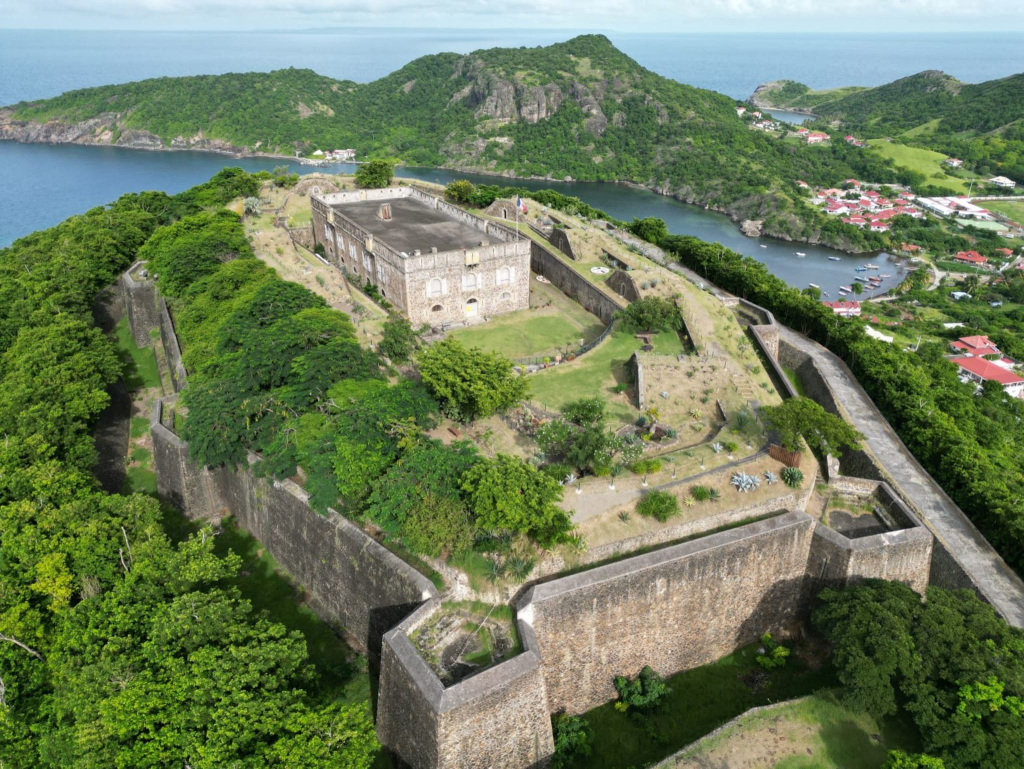
Fort Napoleon des Saintes is one of the most impressive forts in Guadeloupe, a historic monument located on the island of Terre-de-Haut. Built in the early 19th century, this fortification stands as a testament to the island’s rich past and to Guadeloupe’s broader colonial history. Originally constructed to protect the Bay of Les Saintes from enemy attacks, it now stands as one of the island’s most popular tourist attractions.
Fort Napoleon is a must-see landmark for anyone visiting Les Saintes. It offers a breathtaking view over the Bay of Les Saintes and the neighboring islands. Visitors can wander through its peaceful gardens and admire the island’s natural beauty. The site also houses a museum that showcases the history of the island and of Guadeloupe, along with temporary exhibitions dedicated to local art and culture.
My Local Opinion on the Guided Tour
As a native of Guadeloupe, I found the visit to Fort Napoleon overall rich and well-organized, with plenty of interesting information about the site’s history. However, I left with a mixed impression: the guide occasionally added awkward jokes that somewhat broke the serious and majestic atmosphere of the place. A pity, since the site truly deserves a presentation worthy of its heritage.
History of Fort Napoleon: From Battles to Memory
Perched atop Morne Mire, Fort Napoleon tells two centuries of maritime rivalries and reconstructions. From a strategic outpost to a historical museum, it embodies the ambitions, defeats, and resilience of the Saintes archipelago in the face of the great colonial powers.
From Military Beginnings to English Destruction
Before bearing the name Napoleon, the site was home to Fort Louis, built by the French to oversee the Bay of Les Saintes. Its commanding position made it a key defensive point during the wars between France and England for control of the Caribbean. In April 1809, during the Napoleonic Wars, English troops landed on Terre-de-Haut and destroyed the fort. The island remained under British rule for several years.
The 19th-Century Reconstruction
Under the Second Empire, the fort rose again from its ruins. Rebuilt in 1867 using local volcanic stone and lime, it adopted a pentagonal shape inspired by Vauban’s designs. Its bastions were named after Napoleonic generals — Ney, Soult, Lannes, Masséna, and Bertrand. Designed both for surveillance and as housing for the garrison, it never actually saw combat. Its solid architecture now stands as a testament to military expertise turned heritage.
From Defense Post to Place of Memory
During World War II, Fort Napoleon briefly served as a prison, notably for residents of Lebanese or Italian descent considered suspicious by the Vichy regime. After the war, it was left abandoned until being restored in the 1970s. Transformed into a museum dedicated to history and the sea, it now recounts the Battle of the Saintes of 1782 and daily life on the island in earlier times, while offering a stunning panoramic view of the bay — a symbol of peace regained where great colonial fleets once clashed.
The Architecture of Fort Napoleon
Fort Napoleon des Saintes is a fortification located on the island of Terre-de-Haut in the Les Saintes archipelago, Guadeloupe. It was built in 1867 to protect the island from foreign enemies. The fort has a pentagonal shape and is surrounded by dry moats. It measures approximately 100 meters in length and 50 meters in width. Perched on a 114-meter-high hill, it offers a panoramic view over the Bay of Les Saintes.
The Construction Plan
Fort Napoleon was built following the design principles of Vauban, the famous 17th-century French military engineer. The plan includes five bastions, each named after one of Napoleon’s generals: Bastion Lannes, Bastion Soult, Bastion Ney, Bastion Masséna, and Bastion Bertrand. The fort is equipped with a drawbridge, cannons, and a powder magazine.
The Materials Used
Fort Napoleon was constructed using cut stone and red bricks. The walls are 2.5 meters thick to withstand enemy attacks, while the roofs are covered with red tiles. The doors and windows are made of wood.
The fort is also surrounded by stone walls about 3 meters high, built to protect it from assaults. The dry moats surrounding the fort measure 10 meters wide and 5 meters deep, designed to prevent enemies from approaching the structure.
In summary, Fort Napoleon des Saintes is an impressive fortification built according to Vauban’s plans. Constructed with stone and red brick to resist attacks, its dry moats and surrounding stone walls were carefully designed to provide optimal defense.
Visiting Fort Napoleon
Fort Napoleon des Saintes is a must-see historical monument in Guadeloupe that attracts many visitors every year. Touring the fort allows you to explore the island’s rich history while enjoying panoramic views over the Bay of Les Saintes and the surrounding islands.
The Towers
Fort Napoleon is made up of several towers offering stunning views of the landscape. Visitors can explore them while admiring the giant cacti growing around the fort. The towers are also an excellent spot for taking photos of the bay and the lush vegetation that surrounds it.
The Museum
The Fort Napoleon Museum, located on the upper floor, features models and scale replicas that bring the Battle of the Saintes back to life. Visitors can learn about Guadeloupe’s history and discover what daily life was like for the island’s inhabitants. The museum is open every day from 9:00 a.m. to 12:30 p.m., except on public holidays.
In short, a visit to Fort Napoleon is an unforgettable experience for history lovers and anyone seeking breathtaking views. Visitors can explore the towers, dive into Guadeloupe’s past at the museum, and enjoy spectacular panoramas over the Bay of Les Saintes and the nearby islands.
Panoramic View Over the Bay of Les Saintes: What Can You See?
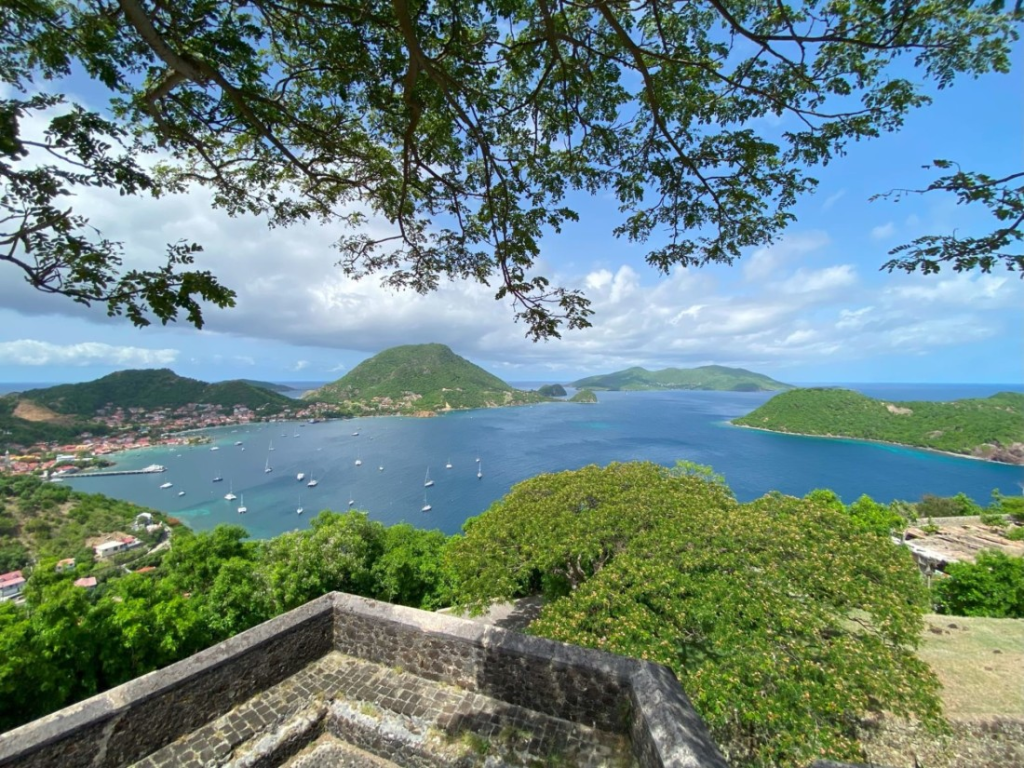
From the ramparts of Fort Napoleon, your gaze falls upon one of the most beautiful bays in the world. At 114 meters above sea level, the view stretches 360 degrees across the surrounding islands and hills — a spectacle that few places in the Caribbean can match with such clarity.
The Pain de Sucre and Terre-de-Bas
Directly in front of the fort, the Pain de Sucre (Sugarloaf) rises from the sea with its steep volcanic peak. Its slopes plunge straight into turquoise waters, where sailboats often anchor sheltered from the wind. Further out, you can spot Terre-de-Bas — the wilder sister island of Terre-de-Haut — recognizable by its dense vegetation and darker hills. On clear days, the horizon seems to blend seamlessly between sea and sky.
Îlet Cabrit and the Military Ruins
To the left, Îlet Cabrit reminds visitors of the archipelago’s defensive past. The ruins of Fort Joséphine can still be seen there, built to guard the channel and protect the harbor. From the fort’s northern bastion, the vantage point reveals the full strategic position of Fort Napoleon — a perfect lookout over every maritime access route.
Dominica on the Horizon
When the weather is clear, the mountainous silhouette of Dominica appears in the distance. The contrast between that island’s lush green slopes and the calm waters of Les Saintes creates a breathtaking scene, often described by travelers as one of the finest panoramas in the Caribbean. It’s also one of the best spots to watch the morning light illuminate the hills — or the sunset casting a golden glow over the bay.
Panoramic View Over the Bay of Les Saintes: What Can You See?
From the ramparts of Fort Napoleon, your gaze falls upon one of the most beautiful bays in the world. At 114 meters above sea level, the view stretches 360 degrees across the surrounding islands and hills — a spectacle that few places in the Caribbean can match with such clarity.
The Pain de Sucre and Terre-de-Bas
Directly in front of the fort, the Pain de Sucre (Sugarloaf) rises from the sea with its steep volcanic peak. Its slopes plunge straight into turquoise waters, where sailboats often anchor sheltered from the wind. Further out, you can spot Terre-de-Bas — the wilder sister island of Terre-de-Haut — recognizable by its dense vegetation and darker hills. On clear days, the horizon seems to blend seamlessly between sea and sky.
Îlet Cabrit and the Military Ruins
To the left, Îlet Cabrit reminds visitors of the archipelago’s defensive past. The ruins of Fort Joséphine can still be seen there, built to guard the channel and protect the harbor. From the fort’s northern bastion, the vantage point reveals the full strategic position of Fort Napoleon — a perfect lookout over every maritime access route.
Dominica on the Horizon
When the weather is clear, the mountainous silhouette of Dominica appears in the distance. The contrast between that island’s lush green slopes and the calm waters of Les Saintes creates a breathtaking scene, often described by travelers as one of the finest panoramas in the Caribbean. It’s also one of the best spots to watch the morning light illuminate the hills — or the sunset casting a golden glow over the bay.