Every hot spring in Guadeloupe is free, and every one of them sits on Basse-Terre, the volcanic wing of the island, between the slopes of La Soufrière and the coast at Bouillante. The catch is the temperature: when the Institut Pasteur measured the public pools for the health agency in 2024, readings ran from about 25 °C (77 °F) in a forest basin at Capesterre to 39.4 °C (103 °F) at the Bain du Curé by the sea. “Hot spring” here can mean a bath, or it can mean a pleasantly warm pond.
What decides your day is three things: how warm the water really is, whether you can drive to the edge or have to hike in, and one health rule that applies to the freshwater pools (keep your head out). The springs pair naturally with a waterfall, a volcano hike or a sunset on the west coast, so if you are still building the rest of the trip, read our things to do in Guadeloupe guide first and slot the warm water in around it.
Which hot spring is the warmest?
Forget the “45 °C” and “70 °C” figures you see quoted. Those are the temperatures where the water leaves the rock or the power plant, not what you sit in. The table below uses the water temperatures the Institut Pasteur de la Guadeloupe recorded in the bathing pools in March, June, September and December 2024, for the regional health agency (ARS).
| Spring | Commune | Water in 2024 | Getting in |
|---|---|---|---|
| Bain du Curé | Bouillante | 37.3 to 39.4 °C | End of Anse à Sable beach |
| Geothermal outlet | Bouillante | 33.2 to 38 °C (sea) | River mouth, in town |
| Grosse Corde | Capesterre-Belle-Eau | 33.5 to 38 °C | Natural pool, local spot |
| Bain de Thomas | Bouillante | 31.5 to 39.6 °C (sea) | Rocks at the shoreline |
| Bain des Amours | Gourbeyre | 33.4 to 33.9 °C | Short walk from the road |
| Bains Jaunes | Saint-Claude | 20.3 to 32.8 °C | Next to the car park |
| Morphy | Pointe-Noire | 28.1 to 29.2 °C | Local pool |
| Sofaïa | Sainte-Rose | About 31 °C | Showers, not a pool |
| Matouba | Saint-Claude | Not measured | 4.7 km round-trip hike |
Two patterns stand out. The sea baths at Bouillante swing the most, because the hot water mixes with the tide. And the Bains Jaunes, usually around 30 °C, dropped to 20.3 °C in March 2024 after heavy rain. Sofaïa’s figure comes from the island tourism office; Matouba has no published reading.
Bains Jaunes: the pool below La Soufrière
The Bains Jaunes (“yellow baths”) sit at 950 m in the national park above Saint-Claude, at the end of the D11, 20 to 25 minutes’ drive from downtown Basse-Terre. The stone basin is fed by water from the Soufrière massif with a faint yellow tint from the sulfur, and the car park is also the main trailhead for the volcano.
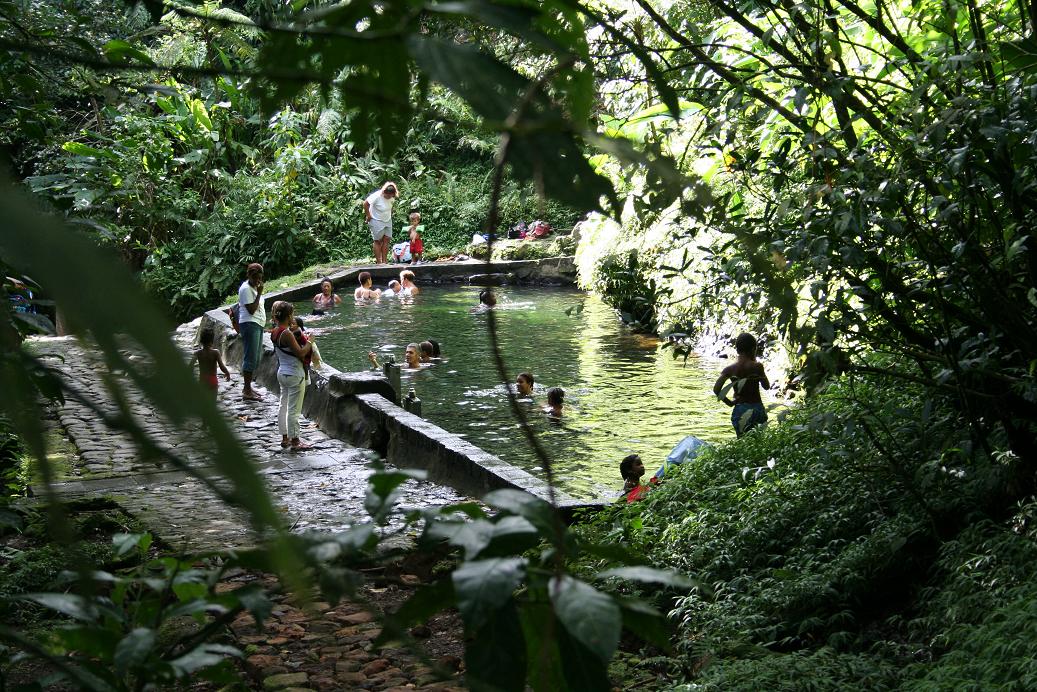
That is the whole point of it. You climb La Soufrière (about 1.5 to 2 hours up, roughly 500 m of climb), come down with rain-soaked legs, and sit in water that is warmer than the air at that altitude. Parking is free but small, and it fills by mid-morning on weekends and school holidays. The access road can be closed by prefectural order after bad weather or volcanic alerts, so check before you drive up. The pool and the best hours are covered in detail on the page where you can discover Bains Jaunes.
The tip that changes everything
Be at the Bains Jaunes car park before 8:30 am, hike first, soak after. You get a parking spot, the summit before the clouds close in, and the pool as your reward instead of your warm-up.
If you would rather go up the volcano with someone who reads the weather for a living, guided hikes leave from the same car park.
See guided tours in Guadeloupe on TripadvisorTripadvisor · affiliate link · same price for you
Bain des Amours, near Dolé in Gourbeyre
This is the most reliable warm pool on the island. In all four 2024 samples, the Bain des Amours sat between 33.4 and 33.9 °C (about 92 °F), whatever the rain did. It is a small built basin in the forest of Dolé, in the hills of Gourbeyre south of Basse-Terre, about 10 minutes on foot from where you leave the car.
It is small, so go early on a weekday if you can. The larger public basin of Dolé, a few minutes downhill, was closed for all of 2024 and the health agency could not sample it, so do not plan around it. The path in and the best hours are on the page about the Bain des Amours.
Bouillante: where hot water meets the sea
Bouillante means “boiling” in French, and the town on the west coast of Basse-Terre earns it: hot water seeps out along the shore and a geothermal power plant runs on it. Here you bathe in the Caribbean itself, warmed from below, and the water changes with every wave. The health agency found no thermophilic amoebae in the sea samples in 2024.
The bath by the power plant
The plant uses deep hot water to make electricity, then releases it at the mouth of a small river, announced at around 45 °C. Where people actually sit, the 2024 samples read 33.2 to 38 °C. It is free, right in town and easy to reach, which is why it is the one most visitors find first. Every warm spot along this coast is in our guide to Bouillante hot springs.
Bain de Thomas and the Bain du Curé
South of town, at Pointe Joubert, the Bain de Thomas is a rough stone ring at the waterline where a spring that leaves the rock at over 70 °C mixes with the sea. There are no changing rooms and no lifeguard, the rocks are slippery, and the heat varies from one hand-width to the next. Bring water shoes and go at the end of the day, when everyone does, for the sunset. Read Bain de Thomas: what to know before you step in near the source.
At the far end of Anse à Sable beach under the cliff, the Bain du Curé is a set of old tiled concrete tubs fed by a thin stream of sulfur water. It is the hottest pool in the 2024 survey, 38.5 °C on average. It is not pretty, but it is properly hot. Malendure, also in Bouillante, is one of the few places where divers can feel hot water venting from the seabed, which makes scuba diving in Guadeloupe a good add-on to a Bouillante day.
Sofaïa: sulfur showers above Sainte-Rose
Sofaïa is in the rainforest hills above Sainte-Rose, in the north of Basse-Terre, with a view down over the Lamentin plain and the Grand Cul-de-sac Marin lagoon. The spring was found after the 1843 earthquake. Since 1996 it has run through open-air showers rather than a pool, renovated in 2019, at about 31 °C.
So you stand under it, you don’t soak in it. The smell of sulfur is strong, the water is said to be good for skin and joints, and it costs nothing. The Sofaïa loop trail starts nearby and leads to the Saut des Trois Cornes, which is why Sofaïa often ends up on the same day as the waterfalls in Guadeloupe of the north. More on the showers on the page with more about Sofaïa baths.
Matouba: the springs you hike for
The Matouba hot springs are the only ones here that you earn. The national park trail starts at the Matouba forest house above Saint-Claude: 4.7 km round trip, about 3 hours, 383 m of climb, rated medium, between 681 and 1,042 m of altitude. The water now comes out through outdoor showers built for the purpose.
Signposting thins out after the Rivière Rouge crossing, so download the route before you go and watch for the markers. The car park is not supervised: leave nothing in the car. The full route is on the page to discover Matouba hot springs, and if you like this kind of walk, also read: hiking in Guadeloupe.
The one safety rule: keep your head out
Warm freshwater pools can carry Naegleria fowleri, an amoeba that is harmless if you swallow it but can be fatal if water goes up your nose. It is rare, and it is real: a 9-year-old boy died in Guadeloupe in April 2008 after bathing in a geothermal pool, and in March 2023 the count at Grosse Corde passed 100 per liter.
The good news is that no N. fowleri turned up in any 2024 sample, and none in the sea. Other Naegleria did, including twice at the Bain des Amours. The rule posted by the health agency is simple: keep your head above water, no diving, no jumping in, don’t drink it. It applies to every freshwater pool on this page, whatever the latest result says.
Flo’s advice
With kids, I pick the sea baths at Bouillante or the Sofaïa showers. Children dunk their heads without thinking, and in the sea or under a shower that habit does not matter. Leave the silver jewelry at home too: the sulfur water at the Bains Jaunes and the Bain du Curé tarnishes it.
How to plan a hot spring day
The springs cluster in three zones, and none of them has a bus that gets you there at a useful hour. With a rental car, you can do one zone a day without rushing.
- South Basse-Terre: La Soufrière hike and the Bains Jaunes in the morning, Bain des Amours in the afternoon, or Matouba instead of the volcano if the summit is in cloud.
- West coast: snorkeling or diving at Malendure, lunch in Bouillante, then the Bain de Thomas or the Bain du Curé at sunset.
- North Basse-Terre: Sofaïa showers after the loop to the Saut des Trois Cornes, then down to the coast at Sainte-Rose.
Flo’s honest take
Go if
You are hiking La Soufrière anyway, you want a free, local evening at Bouillante, or you like your soak with rainforest around it instead of a spa menu.
Skip if
You picture Iceland or a resort hot tub. There are no changing rooms at most sites, the pools are small and shared, and on a rainy week the Bains Jaunes can be barely warmer than a lake.
Keep reading. The west-coast plan above works best with a mask in the bag, so look at where to go snorkeling in Guadeloupe before you drive to Bouillante. And if warm water is not enough action for you, the Atlantic side of Grande-Terre has the waves: see also Guadeloupe surf.
Guadeloupe hot springs: your questions
Do the hot springs in Guadeloupe cost anything?
No. The Bains Jaunes, Bain des Amours, the Bouillante sea baths, Sofaïa and Matouba are all free, and so is parking where there is any. The only cost is getting there, which in practice means a rental car.
Is it safe to bathe in the hot springs?
Yes, if you follow the one rule: keep your head above water in the freshwater pools, no diving and no drinking. The risk is an amoeba that enters through the nose. None of the dangerous species was found in the 2024 samples, but the advice stands. The sea baths at Bouillante showed no amoebae at all.
Are there hot springs on Grande-Terre?
Not that you can bathe in. Grande-Terre is flat limestone; the hot water comes from the volcano, so every spring on this page is on Basse-Terre, mostly around La Soufrière and Bouillante. From Grande-Terre, plan a full day trip.
Why is the water at the Bains Jaunes yellow?
Sulfur. The water rises from the Soufrière massif and carries a light yellow tint and the smell to go with it.
What is the best time of day for the hot springs?
Early morning for the Bains Jaunes, before the car park fills and the summit clouds over. Morning on a weekday for the Bain des Amours, which is small. Late afternoon for the Bouillante sea baths, when the sun goes down over the Caribbean.
Before you go
Book your rental car before you land. No bus reaches the Bains Jaunes car park, the Matouba trailhead or Bouillante at sunset.
The springs are spread over three corners of Basse-Terre, up mountain roads. Airport counters run short in high season, so lock a car in early.
Europcar · affiliate link · same price for you
Some links on this page are affiliate links. You pay the same price. It's how the site stays free of pop-ups and sponsored rankings.